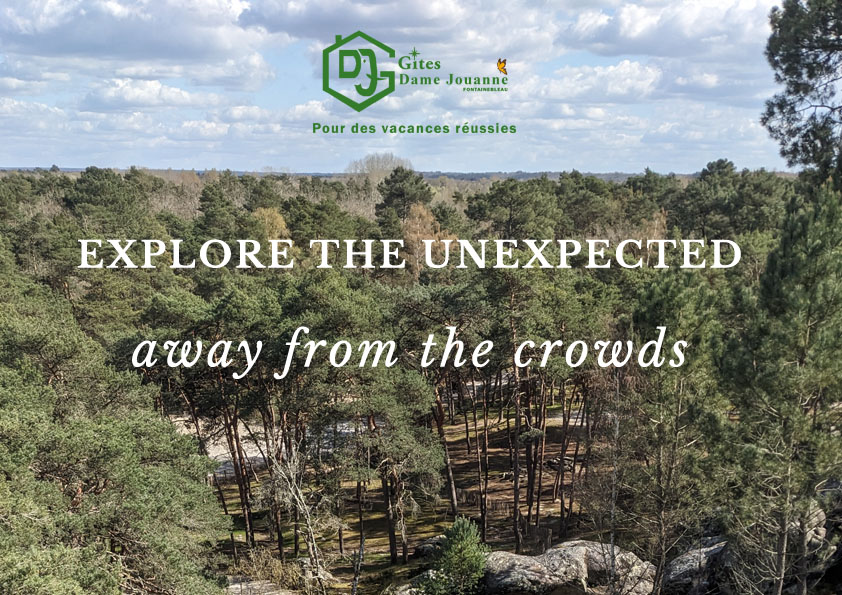
the slow tourism of fontainebleau forest; the secret jewel
- 7 April 2026
- Activities, Bouldering
Les Gîtes Dame Jouanne,
The Slow tourism of Fontainebleau Forest, a New Sanctuary
 by Alain Dury
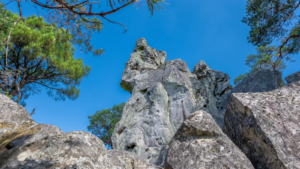 Bouldering is a term used to describe climbing large rocks or boulders without a rope or harness. To protect against injuries from falls and jumps, mats known as crash pads are placed on the ground, and other climbers, called “spotters,” provide assistance and ensure safety. Practiced both indoors and outdoors for many years, bouldering has now become a major climbing discipline in its own right.
While some boulder problems go straight up to the top, others move sideways across the rock (called traverses). But the most spectacular variation is probably the “Highball”: boulders so high that a safe landing is no longer guaranteed. Here, the line between free soloing and bouldering becomes blurry. In Larchant, just a stone’s throw from our gîtes, stands one of the most famous highballs in the world: the legendary Dame Jouanne boulder, towering at nearly 10 meters high!
The great thing about bouldering is that it requires relatively little gear: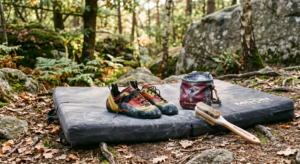
Climbing shoes: This is the only major expense. For beginners, choose a snug but comfortable shoe with low pre-tension. If you only associate learning foot placement with pain, you will struggle to progress!
Chalk: To keep your hands dry. A large chalk bag (often called a chalk bucket) placed on the ground is ideal for bouldering.
Brushes: It is absolutely fundamental to carefully clean the holds after you climb. By brushing away your chalk marks and rubber residue, you leave a clean, grippy rock for the next climbers. It is a sign of great respect for nature and the community.
Crash pads: These mats reduce the risk of injury upon impact. You will often need more than one to safely protect a single boulder problem.
The little extras: Tape to protect your fingers, a first aid kit, and a small towel or scraper to clean your shoes before climbing.
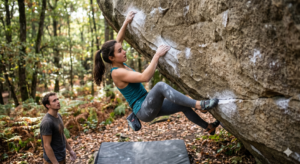 For many, bouldering brings to mind images of highly muscular athletes. However, when a 10-year-old girl tackles a boulder while muscular giants struggle to get off the ground, you quickly understand that bouldering is first and foremost a sport of creativity and adaptability! As we grow older, our brains often get locked into the mindset of “I’m too weak, I don’t have the strength.” To break this vicious circle:
Focus on traverses first: They are excellent for developing your footwork on vertical walls.
Master small holds: Stick to vertical to slightly overhanging routes before tackling steep overhangs that require intense body tension.
Climb with others: Exchange ideas on movement solutions and avoid an overly competitive atmosphere.
Your mindset is crucial. Be creative and playful! Have fun and avoid constantly comparing yourself to your peers. Focus on what you learn with every move. Never forget: bouldering problems are there to be outsmarted, not conquered by brute force.
After a long day of trying hard and learning on the Larchant sandstone, the best thing to do is let your body recover. This is exactly the experience of rest and conviviality that we offer at Gîtes Dame Jouanne, the perfect base camp for your forest adventures.